
La Quinta, CA · Garage Door Service
Garage Door Installation Built for La Quinta's Heat and Housing Stock
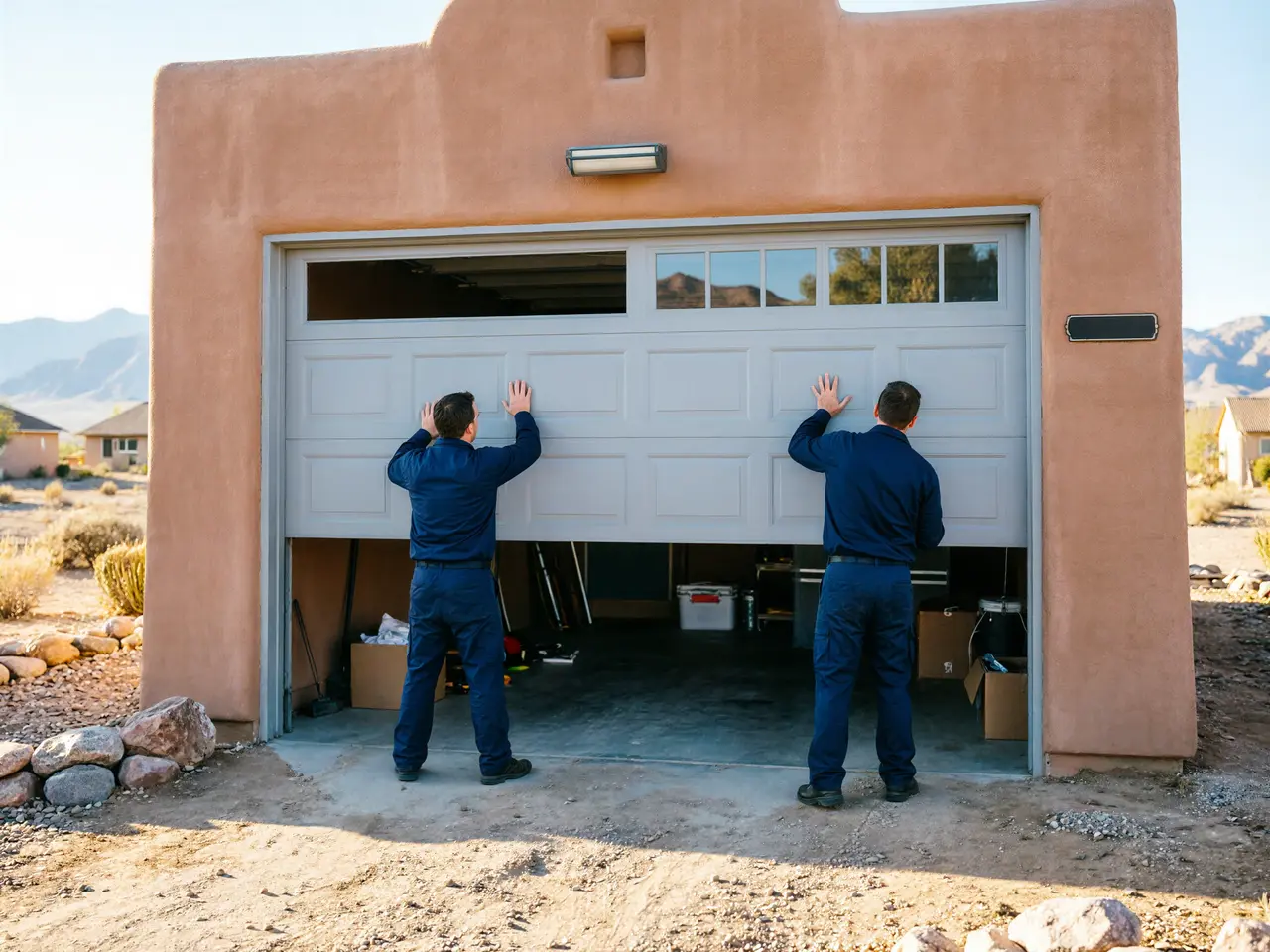
La Quinta Garage Door Pros installs and replaces garage doors built for 1980s-90s desert homes and severe summer heat. Serving La Quinta and nearby communities.
- Repairs & new doors
- Springs & openers
- Serving 7 nearby communities
What You Pay
We don't post a flat number here because what you pay depends on whether you're replacing a door and opener together or just the door, and whether the existing track and header are still square. What we can tell you is what drives the cost on most La Quinta jobs: the house. With a median build year of 1987, a lot of homes in this area still have the original jamb and header framing, and a new door sometimes needs bracket or track work that a newer house wouldn't. Insulated steel doors cost more up front than uninsulated ones, but in a severe heat climate the insulation pays for itself in a quieter opener and a garage that doesn't bake your stored paint cans and tools.
We walk every job in person before quoting, because a torsion spring swap on a 1980s double door and a full door-and-opener replacement are two different jobs with two different price tags. If your springs, cables, and hinges are original to a late-80s build, we'll tell you plainly if patch repair is throwing money at parts that are going to fail again within a year anyway.
How We Fix It
On a house from the 1977-1999 build window, the first thing we check is whether the torsion spring and drum setup matches what the door actually weighs now - insulated retrofit panels are heavier than the single-layer steel that shipped standard back then, and an original spring sized for the old door will fail early under the new one. We re-size the spring to the current door weight, not the sticker on the old one.
We also replace the nylon rollers with steel ball-bearing rollers as a matter of course on severe-heat installs, because nylon softens and cracks faster here than it does in milder climates. Track alignment gets checked against the header, since decades of summer expansion and contraction can walk a track out of true even if nothing looks obviously bent. For openers, we size the motor to the door weight and set the travel limits by hand rather than trusting factory defaults, since a door that's gained weight from an insulation retrofit needs more lift than the opener's stock settings assume.
What You Are Seeing
If your door is original to a house built in the 1980s or 90s, you're probably seeing one or more of: a door that drifts down a few inches after the opener closes it, a spring that makes a flat metallic pop when the door starts to move, or panels that have faded and warped slightly on the side that gets the most sun through the afternoon. None of that is cosmetic only - a warped panel changes how the roller sits in the track, and that's what turns into a jammed door at the worst time.
Across the eleven neighborhoods that make up this stretch of the valley, the stock is overwhelmingly 1980s and 90s construction, which means the same torsion spring gauge and the same steel panel profile show up house after house. If your neighbor's door failed last summer and yours is the same age, yours is on the same clock, not a different one.
Why This Fails Locally
La Quinta sits in a severe heat band, and that heat is what turns a fifteen-year spring into a five-year spring. Steel expands and contracts every single day through a long cooling season, and a torsion spring under constant load does that expansion cycle more times per year here than it would somewhere milder. That's the mechanical reason original hardware from the late 80s is failing now in clusters rather than one house at a time.
Most garage doors in La Quinta went up between 1977 and 1999, with the median build year sitting at 1987, so a lot of what's failing now is original hardware from that era. Vista Santa Rosa is four miles out, Indian Wells five, and Bermuda Dunes seven - homes in all three ranges share the same late-80s build pattern we see in La Quinta. With 23,542 owner-occupied houses in the service area, a big share of them built before 2000, the opener motors straining against heat-stiffened springs are a common call we get. It's not a defect in any one house. It's the age and the climate working on the same hardware at the same time.
Frequently asked questions
Why did my spring break in summer and not winter?
Heat cycling is harder on torsion springs than cold. In La Quinta's severe heat band, the metal expands and contracts through a long hot season, which fatigues a spring faster than it would in a milder climate. If your spring is original to a house built in the 1980s or 90s, summer failure is the common pattern, not the exception.
Is my door original to the house if it was built in the 1980s?
It's common. A lot of La Quinta homes in this build era still have their original door, track, and sometimes spring, especially if no one's done a renovation. We check the hardware against the door's actual current weight, since insulation retrofits over the years change what the spring needs to lift.
Do you serve areas outside La Quinta itself?
Yes - we cover the surrounding communities as well, including Vista Santa Rosa, Indian Wells, Bermuda Dunes, Coachella, Thermal, Desert Palms, Oasis, Rancho Mirage, Thousand Palms, Mecca, and Sky Valley.
Should I repair or replace an original 1980s door?
Depends on the panel condition more than the age. If the steel is still straight and just needs new rollers, cables, and a properly sized spring, repair makes sense. If panels are warped or faded through, or the door's been patched more than once, replacement usually costs less over a few years than repeated repair calls.
Book garage door service in La Quinta
Call now or request a quote - tell us what the door is doing and where you are.