
La Quinta, CA · Garage Door Service
Roller Replacement for Coachella Garage Doors
Coachella homes run newer than much of the La Quinta service area, built mostly after 1998. That changes which rollers wear out first and what the fix actually costs.
- Repairs & new doors
- Springs & openers
- Serving 7 nearby communities
Getting It Booked In
We work out of La Quinta and cover Coachella as part of that territory, about 8 miles out. When you call about a noisy or jumping door, the first thing we ask is the age of the house, not just the door, because Coachella skews newer than a lot of what we see closer to home. A good chunk of the broader service area was built between 1977 and 1999, with a lot of that stock from the 1980s and 90s, but Coachella itself runs later, closer to 1998 on the median. That one number changes what we expect to find before the truck even leaves La Quinta. We still need you to tell us what the door is doing: grinding on the way up, hanging up at the same spot every time, or rattling the whole frame. That detail, plus the build year, lets us bring the right roller stock instead of guessing on site.
What You Are Seeing
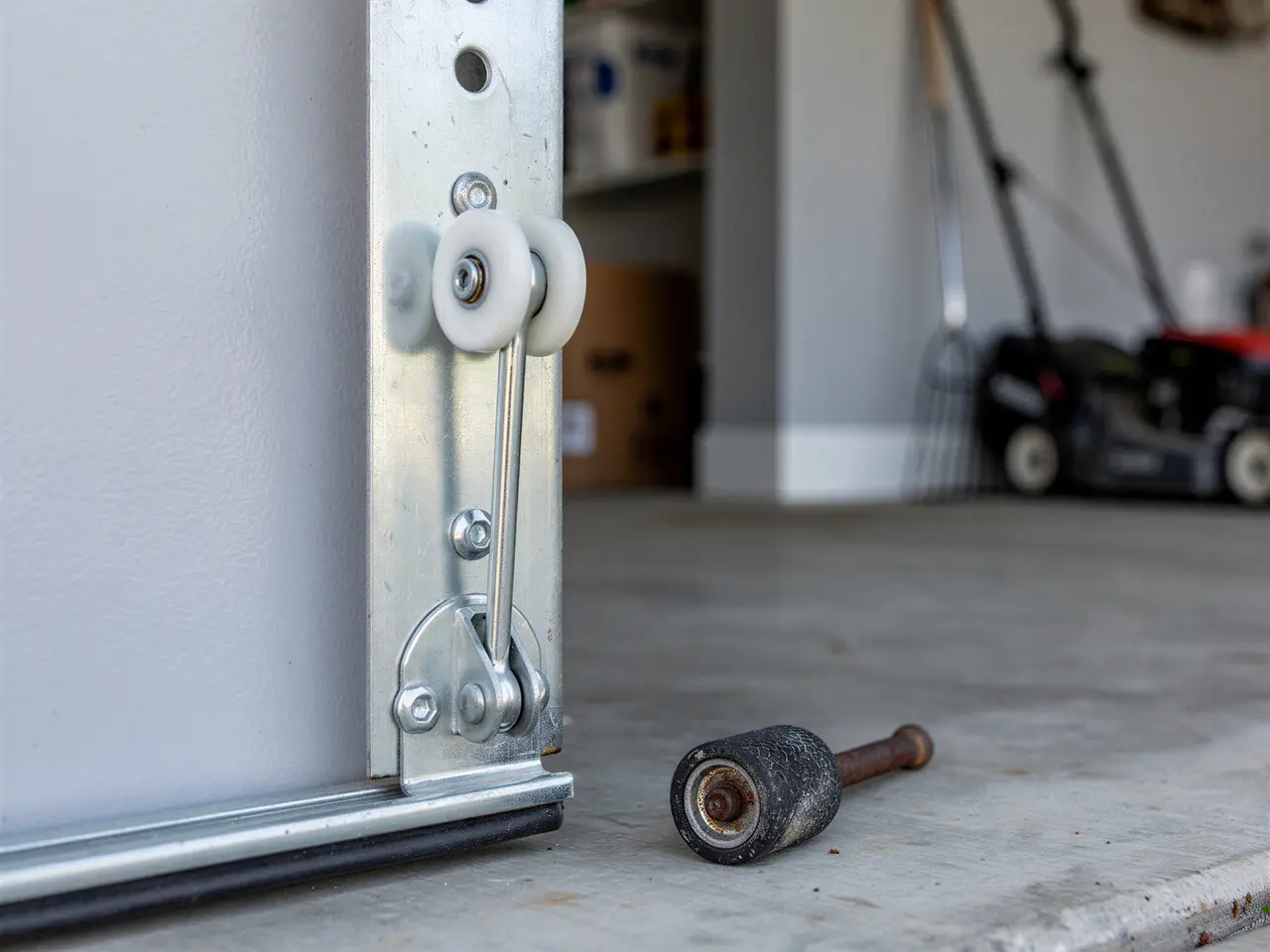
A door built around 1998 was almost certainly fitted with the stamped-steel rollers or early nylon rollers that were standard then, not the sealed ball-bearing nylon rollers that became common later. Steel rollers on original hardware get loud as the bearings dry out, and you'll hear it as a metallic rumble that gets worse near the top of the track where the curve starts. Early nylon rollers crack at the stem instead, and a cracked stem lets the roller wobble sideways in the track, which is what causes a door to catch and jerk rather than run smooth. Either way, by the time you're hearing it daily, the roller has usually already scored the inside of the track, which is extra work beyond just swapping rollers. Severe summer heat here accelerates both failure modes, since repeated expansion and contraction of the track rail loosens brackets faster than it would in a milder climate.
Doing It Yourself
Swapping a single bottom roller on a door that's still on its hinges is within reach for someone comfortable with a wrench and a bit of patience, since the bottom brackets aren't carrying spring tension. The rollers higher up the track are a different matter. With the door built around 1998, you're also likely dealing with original end bearing plates and a track that's been in place for over two decades, and pulling a roller near the top means working close to a wound torsion spring. We'd rather tell you that straight than sell you a quick fix: if more than two rollers are worn, or if any of them are in the top third of the track, that's a job where a slipped spring or a dropped section of track can do real damage to a hand or a knee. Full roller sets on both tracks are a job we do, not a weekend one.
Time on the Job
A straightforward 10-roller replacement, nylon ball-bearing units on both tracks, runs about what you'd expect for a two-car door once the truck is on site, and most of that time goes into checking track alignment after the swap rather than the rollers themselves. Coachella's median household income sits at $67,558, noticeably under the $74,378 figure across the wider area we cover, and we mention that because it's part of why we'll tell you honestly when a repair makes more sense than a pitch toward replacement. If the track is still true and the door only needs rollers, that's the whole job. If the track is bent or the opener's travel settings are off from years of the door catching, that adds time, and we'll say so before we start, not after.
Where This Job Goes Sideways
The thing that turns a roller job into a bigger bill is a track that's been bent from a roller wobbling in it for months before anyone called. Once the track is bowed, new rollers still bind, and at that point you're replacing track sections, not just rollers. With roughly 12,352 households in Coachella and a housing stock centered on the late 1990s, we're seeing more doors now hitting that 20-to-25-year mark where original rollers are failing around the same time as the springs they share a door with. If a spring goes while a roller is already worn, don't force the door open or closed. That's the one call where waiting costs you less than pushing through it.
Frequently asked questions
Why do Coachella garage doors need different rollers than older La Quinta homes?
Coachella's housing is newer on median, around 1998, versus the 1977-1999 range across the whole area we serve. That later build year usually means early nylon or stamped-steel rollers on original hardware, which fail differently than the stock on older doors, so we bring different parts depending on the house.
Can I just replace the noisy roller and leave the rest?
Sometimes, if it's a single bottom roller. But once one roller on a door this age is worn, the others are usually close behind from the same heat exposure and years of use, so we'll check the whole set before we quote just one.
Do you have a shop in Coachella?
No, we run out of La Quinta and cover Coachella as part of our service area, about 8 miles out. We bring roller stock on the truck rather than keeping a separate location in town.
Is a rumbling door always a roller problem?
Not always. Rumbling can also come from a loose track bracket or a worn end bearing plate, both common on doors built around the same era as most Coachella homes. We check the track and brackets along with the rollers before we say what's actually worn.
More garage door services in Coachella
Book garage door service in La Quinta
Call now or request a quote - tell us what the door is doing and where you are.